

新闻未分类
随着半导体、电动汽车、航空航天、射频和工业电子应用领域功率密度的不断提高,基板材料已成为热管理和长期可靠性的关键因素。
在先进的陶瓷基板中,有三种材料经常被考虑:
每种材料在导热性、机械强度、抗热冲击性和成本方面都各有优势。
我们将对这三种材料进行比较,以帮助您更清晰地选择合适的材料。
| 属性 | 氮化铝 | 氧化陂 | Si₃N₄ |
|---|---|---|---|
| 导热系数 | 170–230 W/m·K | 250–330 W/m·K | 70–95 W/m·K |
| 抗弯强度 | 300–400 MPa | 200–300 MPa | 700–1000 MPa |
| 断裂韧性 | 2.5–3.5 MPa·m½ | 2–3 MPa·m½ | 6–8 MPa·m½ |
| 热膨胀系数(CTE) | 4.5 ppm/K | 7–8 ppm/K | 3.0–3.3 ppm/K |
| 抗热震性能 | Excellent | Excellent | Excellent |
| 热冲击阻力 | Good | Moderate | Excellent |
| 毒性问题 | None | Significant | None |
| 相对成本 | High | Very High | High |
| 半导体应用 | Very High | Limited | Growing |
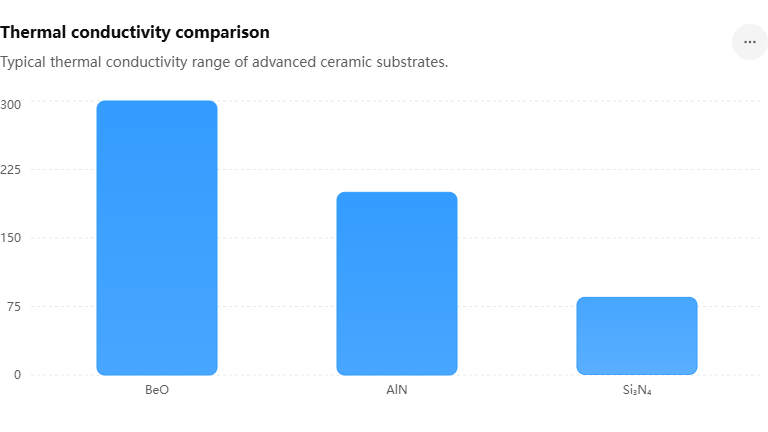
For heat dissipation, thermal conductivity is undoubtedly the most important selection criterion. Among these three materials, alumina (BeO) has the best thermal conductivity, followed by aluminum nitride. Of course, considering only thermal conductivity is not comprehensive.
Because from a mechanical reliability perspective, both AlN and BeO are inferior to Si₃N₄. Compared with the other two materials, silicon nitride has a strength that is 2–3 times higher. At the same time, its fracture toughness is second only to zirconia, and Si₃N₄ also has the best thermal shock resistance among the three materials.Therefore, the final material selection should be made by balancing thermal conductivity requirements against mechanical reliability and service conditions.
Lower CTE generally means better matching with silicon chips.
| Material | CTE |
|---|---|
| Si₃N₄ | 3.0–3.3 ppm/K |
| Silicon | 3–4 ppm/K |
| AlN | 4.5 ppm/K |
| BeO | 7–8 ppm/K |
In terms of cost, the order is silicon nitride → aluminum nitride → beryllium oxide, but the actual price also depends on the size of the material, special processing requirements, and processing difficulty.
In practical applications, I generally see aluminum nitride being selected when thermal conductivity and heat dissipation are the primary concerns, such as in semiconductor wafer processing and packaging equipment. Silicon nitride, on the other hand, is often the better choice when higher mechanical strength, reliability, and resistance to impact or thermal shock are required.
As for beryllium oxide, I have observed that regulatory and handling concerns have gradually shifted much of the market toward aluminum nitride. However, when the application demands exceptionally high thermal conductivity, BeO still remains an important material, particularly in military, aerospace, and other high-performance systems.
In my view, there is no single “best” ceramic substrate material. The right choice always depends on the specific requirements of the application. If I were to simplify the selection criteria:
If the goal is maximum thermal conductivity, I would consider BeO.
If the goal is achieving the best balance between thermal performance and electrical insulation, I would choose AlN.
If mechanical strength, durability, and long-term reliability are the top priorities, I would recommend Si₃N₄.
Ultimately, I believe material selection should start with the application's actual operating requirements rather than focusing on a single property.

English

German

Japanese

Spanish
中国广东省东莞市松山湖怡乐路1号2号楼南区1单元B门306室(邮编:523808)
